Posted On: August 27, 2026
Posted By: KSNM DRIP
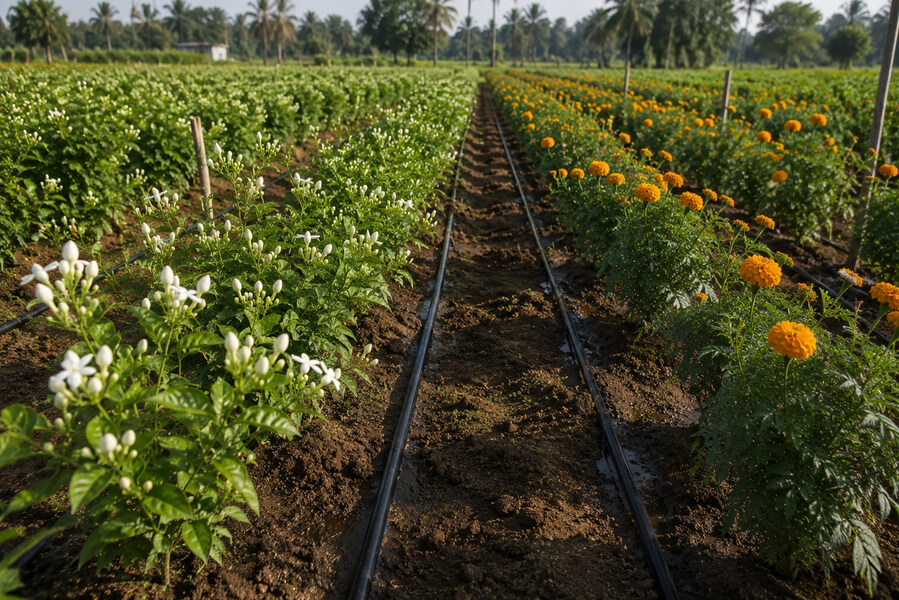
Jasmine and marigold are two of India's most commercially grown festival flowers, with demand peaking sharply between August and October. Getting the water management right is what separates a profitable harvest from a missed opportunity. In this guide, you'll find everything jasmine and marigold growers need to set up and manage drip irrigation.
Festival seasons across India drive one of the highest spikes in flower demand of the year. Between August and October, jasmine and marigold farmers face a tight window to deliver consistent and high-quality blooms for occasions like Onam, Navratri, and Diwali. Miss the timing, and the market moves on without you.
According to the National Horticulture Board, flower cultivation in India covers over 317,000 hectares, and a significant share of that production is concentrated in this exact season.
Drip irrigation has become one of the most reliable ways growers protect that window.
Drip irrigation delivers water directly to the root zone of each plant at a controlled rate. For jasmine and marigold crops grown under festival timelines, this precision matters more than most growers initially realise. Both crops are sensitive to waterlogging, and overhead irrigation methods often create moisture on the foliage and flower buds, increasing the risk of fungal infections and bloom damage.
A study published by the Indian Council of Agricultural Research found that drip-irrigated flower crops used up to 40% less water compared to flood irrigation methods while producing a measurably higher number of marketable blooms per plant. For a small or mid-size flower farm operating on tight margins before a festival season, that efficiency directly affects profitability.
The other advantage is scheduling. Drip systems allow you to automate irrigation cycles based on soil moisture levels, which is especially useful during the August to October period when weather patterns across South and Central India can shift quickly between dry spells and heavy rain.
The August to October period presents a unique challenge for flower crop water management. Monsoon tail-end conditions create inconsistent soil moisture. Some weeks bring excess rainfall, others leave fields dry for extended stretches.
Jasmine roots sitting in waterlogged soil for even 48 hours can develop root rot. Marigold, while slightly more forgiving, starts dropping blooms prematurely when soil moisture fluctuates too sharply.
Drip irrigation gives you control during this unpredictability. You can reduce drip output during heavy rain periods and increase it during dry stretches without disturbing the root zone or causing soil erosion. Festival flower farming at this scale requires this level of control.
Irrigation scheduling during this period should target soil moisture at 60 to 70% field capacity for marigold and slightly higher at 70 to 80% for jasmine, which prefers more consistent moisture to support its continuous flowering habit.
Setting up drip irrigation for these two crops doesn't require complex infrastructure, but a few decisions early on determine how well the system performs through the season.
Start with lateral spacing. For marigold planted at standard spacing of 45 x 45 cm, one drip lateral per two rows with emitters placed at 30 cm intervals works efficiently.
For jasmine, which is typically planted at wider spacing of 60 x 60 cm or more, one lateral per row with emitters at 45 cm intervals ensures adequate coverage of the root zone.
Emitter discharge rate matters here. A flow rate of 2 to 4 litres per hour suits both crops well during the August to October season. Higher discharge rates increase the risk of surface runoff on sloped land, which reduces water-use efficiency and can expose shallow roots.
For a broader look at how drip compares to other systems in this regard, read our guide on drip irrigation vs sprinkler irrigation.
The most common mistake in flower crop water management during this period is running the drip system on a fixed schedule without accounting for actual soil moisture.
Farmers who irrigate on a daily timer regardless of recent rainfall end up with oversaturated root zones, especially in clay-heavy soils common across parts of Karnataka, Tamil Nadu, and Maharashtra.
Installing a simple tensiometer or a soil moisture sensor at root depth takes the guesswork out of scheduling. These tools are inexpensive relative to the cost of losing a crop ahead of peak festival demand.
The second mistake is skipping filtration. Drip emitters clog easily with sediment, organic matter, and hard water deposits. A screen filter or disc filter at the head unit, cleaned every two to three weeks, keeps emitters flowing at their rated discharge and prevents dry patches from developing mid-field. KSNM's range of drip irrigation filters and venturi are built specifically for this.
Learn more about common drip irrigation errors and how to fix them on our dedicated guide on the KSNM blog
Jasmine and marigold grown with well-managed drip irrigation consistently outperform crops irrigated by flood or sprinkler methods during the August to October festival window.
The combination of precise water delivery, fertigation capability, and scheduling flexibility gives growers a meaningful advantage when market timing is everything.
Start by mapping your field layout and identifying the lateral and emitter configuration that suits your crop spacing. Install a filter unit, set your discharge rate, and build in a soil moisture monitoring routine before the season begins.





 Drum Seeder and Cono...
September 02, 2026
Drum Seeder and Cono...
September 02, 2026
 Jasmine and Marigold...
August 27, 2026
Jasmine and Marigold...
August 27, 2026
 Understanding KSNM's...
August 20, 2026
Understanding KSNM's...
August 20, 2026
 Water Crisis 2026: W...
August 06, 2026
Water Crisis 2026: W...
August 06, 2026
 Cotton Drip Irrigati...
August 13, 2026
Cotton Drip Irrigati...
August 13, 2026
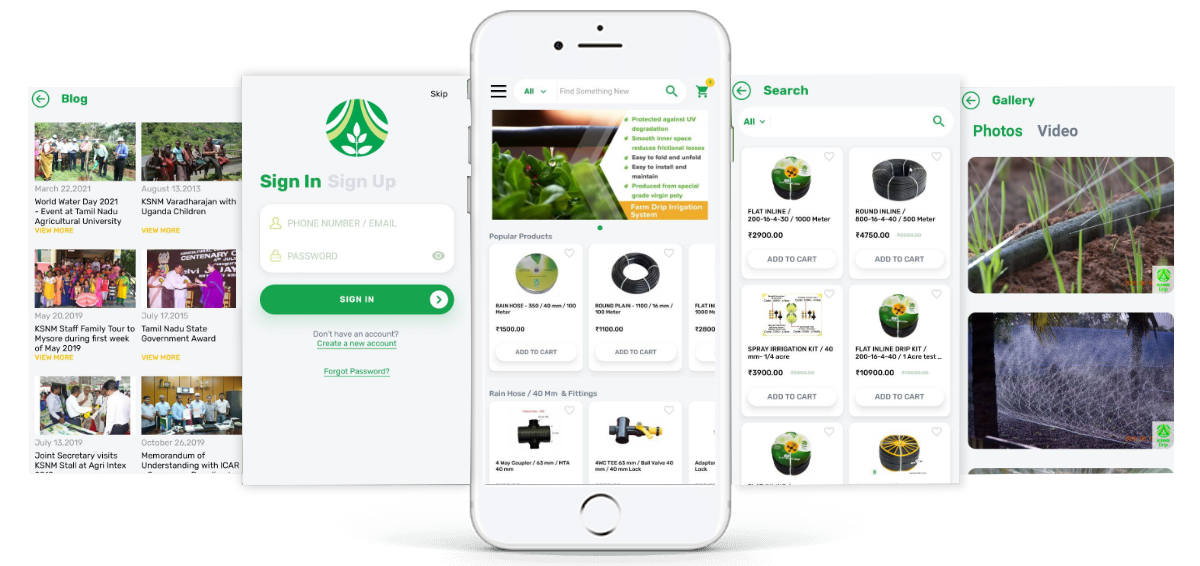
Introducing KSNM Drip’s Mobile App
Through our app’s convenience, start enjoying easy access, better experience and simple payment process. Download our App and begin your cart buying right away.


 Special offer!
 Track Order