Posted On: September 02, 2026
Posted By: KSNM DRIP
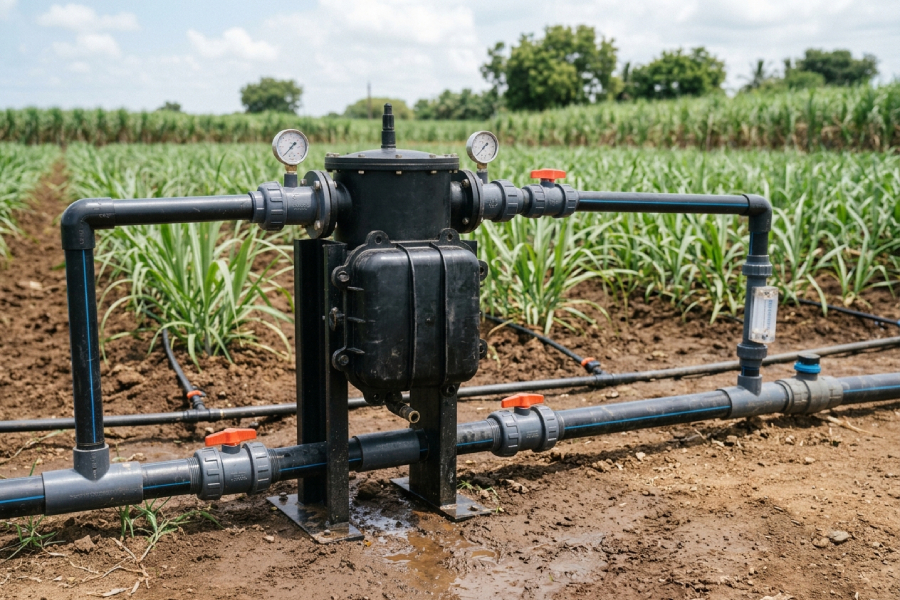
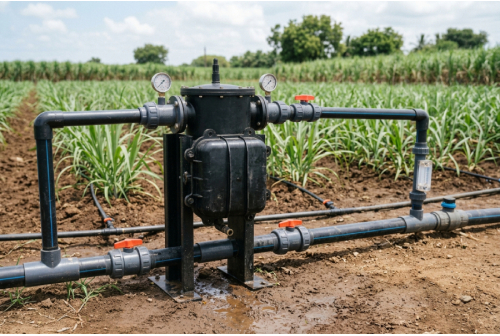
A drip irrigation filter may be small, but it carries the entire weight of your system's long-term performance. This guide breaks down why filters are the most critical yet overlooked component in drip irrigation, and how choosing the right one protects your investment, your emitters, and your yield.
Most drip irrigation systems fail not because of poor pipes or faulty emitters. They fail because of one small, often ignored part: the filter. Research by the Food and Agriculture Organization (FAO) shows that clogged emitters are the leading cause of drip system inefficiency across smallholder farms globally.
Drip irrigation delivers water directly to the root zone, which makes precision non-negotiable. And precision begins at the filter. In this guide, you'll learn why filters matter more than most farmers realize, which type suits your water source and crop, and how to maintain them so your system runs at full efficiency season after season.
Filters don't get the attention they deserve because they work silently. When a pump fails, you know immediately. When an emitter clogs, you see it in the field. But when a filter underperforms, the damage builds slowly: reduced flow, uneven water distribution, and emitter blockages that take weeks to surface. By the time a farmer notices, significant yield loss has already occurred.
Drip irrigation operates on pressure and precision. The emitters that release water have openings as small as 0.5mm. Any particle larger than that, whether it's sand, algae, or organic debris, can cause a blockage. A properly selected filter intercepts these particles before they ever reach the laterals. If you want to understand exactly how blockages develop and spread through a system, KSNM's guide on common causes of dripper clogging and prevention strategies breaks it down in full detail.
Not all filters work the same way, and choosing the wrong type for your water source is one of the most common mistakes in drip irrigation installation.
Screen Filters are the most widely used. They catch sand, silt, and fine particles using a mesh screen. These work well when your water source is relatively clean, such as a borewell or treated canal water. They're affordable and easy to clean, but they clog quickly if your water carries high organic load.
Disk Filters use a stack of grooved plastic discs to trap particles from multiple directions. They handle organic matter and algae better than screen filters, making them the right choice for open water sources like ponds, tanks, or rivers. Agricultural engineers at institutions like the Indian Council of Agricultural Research (ICAR) recommend disc filters for surface water sources, precisely because of their multi-directional filtration. Explore KSNM's disk and screen filter range to find the right fit for your water source and farm size.
Sand Media Filters are built for the heaviest loads. When water carries high amounts of silt, sand, or biological material, a sand media filter runs the water through a bed of silica sand to strip out contaminants.
Centrifugal (Hydrocyclone) Filters remove heavy sand and gravel using centrifugal force. They're used as pre-filters in high-sediment conditions and must always be paired with a screen or disk filter downstream. They don't remove light particles or organic matter on their own.
The right filter depends on your water source, and your emitter type.
Start with a water quality test. If you're drawing from a borewell, screen filtration is often enough. If you're using a surface water body, disk or sand media filtration is safer. For water with mixed contamination, layered filtration works best: a centrifugal filter first, followed by a disc or screen filter.
Next, match the filter to your emitter's flow path. A drip tape with a 120-mesh emitter needs a filter that catches particles smaller than 125 microns.
Irrigation consultants consistently point out that farmers under-invest in filtration when setting up drip systems, only to spend far more on emitter replacements and system flushing later. Getting filtration right at the start is always the lower-cost decision. If you're planning a new system and want to get the full setup right from the beginning, KSNM's irrigation planning guide for 5-acre and 10-acre farms covers filtration as part of the complete layout process.
A filter that isn't cleaned on schedule eventually becomes the problem it's meant to prevent. As particles accumulate, pressure drops across the filter. Downstream, emitters receive less water than the crop needs. Uniform irrigation, which is the core advantage of a drip system, breaks down.
The standard recommendation is to clean screen and disk filters every 7 to 14 days during active irrigation seasons, or whenever you notice a pressure drop of 20% or more across the filter. Sand media filters require backwashing, either manually or through an automated backwash system.
A quality filtration setup for a one-acre drip system typically costs between 10% and 15% of the total system budget. But the payback is disproportionate. Clean emitters maintain their rated flow for longer. System lifespan extends significantly. And most importantly, the crop receives consistent, uniform moisture throughout the season.
Drip irrigation's core promise is efficiency: less water, better yield, lower input cost. That promise holds only when the system runs clean. Filtration is what keeps it clean.
Drip irrigation is only as reliable as the care built into it at every stage. Filters sit at the very start of that chain. Choosing the right filter for your water quality, installing it correctly, and cleaning it on schedule protects every downstream component you've invested in: the laterals, the emitters, the stakes, and ultimately, the crop itself.
If you're setting up a new drip system or troubleshooting an existing one, start at the filter. Need help choosing the right filter for your water source? Contact KSNM Drip and get expert guidance for your specific field conditions.





 How to Choose Betwee...
October 08, 2026
How to Choose Betwee...
October 08, 2026
 Two Decades of KSNM ...
September 02, 2026
Two Decades of KSNM ...
September 02, 2026
 Tomato Drip Irrigati...
September 02, 2026
Tomato Drip Irrigati...
September 02, 2026
 Filters in Drip Irri...
September 02, 2026
Filters in Drip Irri...
September 02, 2026
 Drum Seeder and Cono...
September 02, 2026
Drum Seeder and Cono...
September 02, 2026
Introducing KSNM Drip’s Mobile App
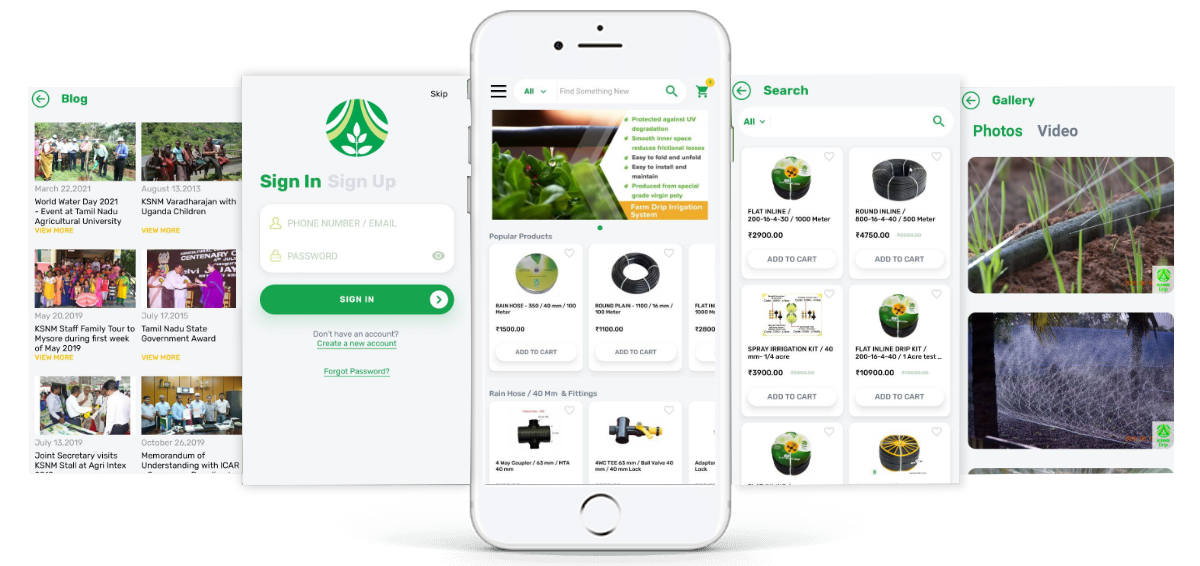
Through our app’s convenience, start enjoying easy access, better experience and simple payment process. Download our App and begin your cart buying right away.


 Special offer!
 Track Order