Posted On: June 15, 2026
Posted By: KSNM DRIP
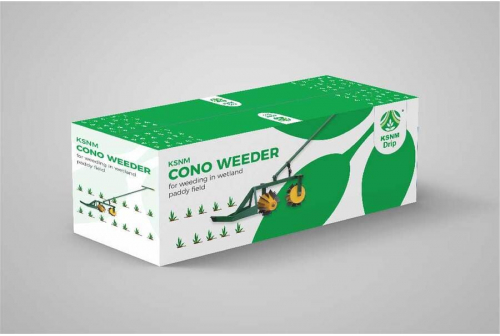
This guide explains how cono weeders help organic rice farmers manage weeds efficiently without chemicals, why they outperform manual weeding, and how KSNM's cono weeder fits into a sustainable paddy farming system.
Weeds steal. They pull nutrients, water, and sunlight directly away from your paddy crop, and in organic farming, you can't reach for herbicides to stop them. That's the wall every organic rice farmer eventually hits.
Studies from the International Rice Research Institute show that uncontrolled weed pressure in paddy fields can reduce rice yields. For organic farmers working without chemical backup, that number demands a serious answer. KSNM Drip’s cono weeder has emerged as one of the most practical, affordable, and field-proven tools available to address this challenge head-on.
A cono weeder is a manual tool with cone-shaped rotating heads that churn the flooded soil between transplanted rows, uprooting young weeds and burying them into the mud. Those buried weeds don't go to waste, they decompose quickly and return nitrogen and organic matter back to your field. You're controlling weeds and feeding your soil in the same pass.
For organic farmers who've removed chemicals from the equation entirely, the cono weeder isn't just a useful tool. It's a foundational part of a system that keeps yields strong, labour costs manageable, and soil health building season after season. Explore KSNM's Cono Weeder built for exactly this kind of demanding, season-long use.
Manual hand weeding works. But it's slow, physically demanding, and expensive when you're paying daily labour across even a modest paddy holding. A single worker using a cono weeder can cover nearly double the area per day compared to hand weeding.
That efficiency gap compounds across a season. Two to three weeding rounds are typically needed in organic paddy cultivation. Each round where you deploy a cono weeder instead of pure hand labour cuts your weeding cost significantly without sacrificing weed control quality. For small farmers managing 1 to 5 acres, that saving directly protects their margin.
The cono weeder also reduces physical strain. Workers push the tool rather than bending and pulling by hand for hours. That matters for long-term farm labour availability. Also, KSNM Drip shares the advantages of a cono weeder.
It does, significantly. Cono weeders operate between transplanted rows, so your row spacing must be consistent enough to allow the tool to pass without damaging rice plants. The standard recommendation for transplanted paddy suited to cono weeding is 20 x 20 cm spacing.
This is where KSNM's Direct Paddy Seeder becomes directly relevant. The two tools work as a system. Consistent plant spacing also improves canopy closure, which suppresses late-season weed emergence naturally.
For farmers exploring complete paddy farm management, KSNM's Drum Seeder and Cono Weeder range is also designed around this integrated approach.
Weed control in organic paddy farming doesn't have to mean back-breaking labour or compromised yields. The cono weeder gives you a mechanical, chemical-free solution that fits naturally into every stage of your paddy calendar, from transplanting to canopy closure.
Ready to make weed control the least of your worries this season? Explore KSNM's full range of farm tools and irrigation solutions built specifically for South Indian farming conditions.





 Drum Seeder and Cono...
September 02, 2026
Drum Seeder and Cono...
September 02, 2026
 Jasmine and Marigold...
August 27, 2026
Jasmine and Marigold...
August 27, 2026
 Understanding KSNM's...
August 20, 2026
Understanding KSNM's...
August 20, 2026
 Water Crisis 2026: W...
August 06, 2026
Water Crisis 2026: W...
August 06, 2026
 Cotton Drip Irrigati...
August 13, 2026
Cotton Drip Irrigati...
August 13, 2026
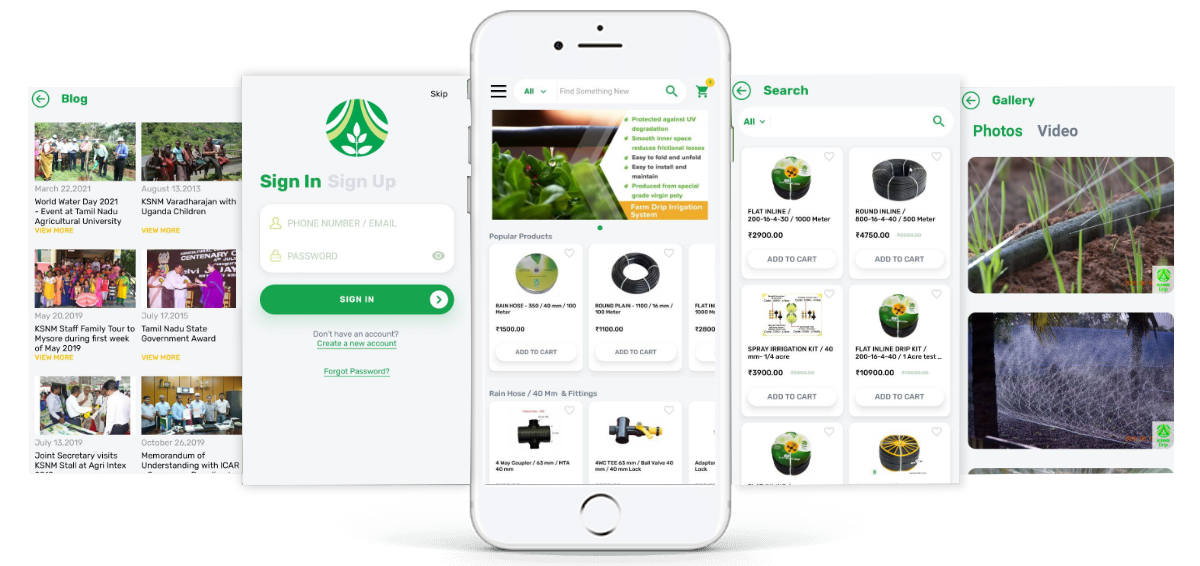
Introducing KSNM Drip’s Mobile App
Through our app’s convenience, start enjoying easy access, better experience and simple payment process. Download our App and begin your cart buying right away.


 Special offer!
 Track Order