Posted On: August 20, 2026
Posted By: KSNM DRIP
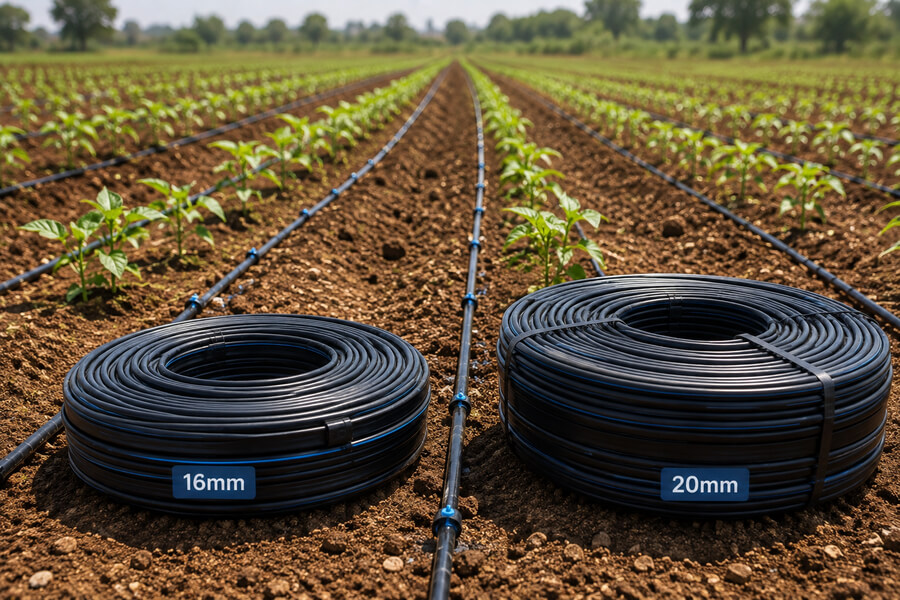
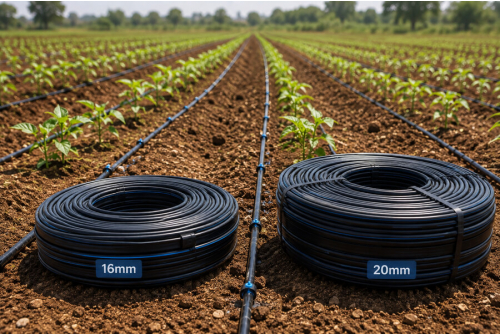
Choosing between 16mm and 20mm drip tape affects water flow, pressure, and crop performance across every row. This guide breaks down KSNM's drip tape options by crop type, soil condition, and farm size so farmers can make the right call before installation.
Pick the wrong drip tape diameter and your entire irrigation system underperforms, because the pipe carrying water to your crops can't deliver it at the right pressure and flow rate. Drip irrigation tape is where water meets the root zone, and the diameter you choose determines how efficiently that delivery actually happens.
KSNM Drip manufactures both 16mm and 20mm drip tape, each built for different farm conditions, crop water demands, and field lengths. They're not interchangeable. One suits shorter runs and closer row spacing. The other handles longer field lengths and higher flow requirements without pressure drop.
In this guide, you'll learn exactly how 16mm and 20mm drip tape differ, which crops and conditions suit each size, and how to make the right choice before you install a single metre.
The core difference between 16mm and 20mm drip tape comes down to internal diameter, which directly controls flow rate and pressure handling across the pipe run. A wider pipe carries more water per minute at lower friction loss, which matters most when your field runs are long or your crop has high water demand.
16mm drip tape works well for shorter lateral runs, typically up to 80 to 100 metres, and suits crops with moderate water requirements like vegetables, onions, and pulses. The smaller diameter keeps the system compact, easy to handle, and cost-effective for farms where lateral runs stay within that range.
20mm drip tape handles longer runs, from 100 metres upward, without the pressure drop that limits 16mm performance at distance. Crops like sugarcane, banana, and cotton benefit from the wider diameter maintaining pressure along the full lateral length.
Choosing 16mm on a long sugarcane run doesn't just reduce flow at the far end. It creates an invisible yield gap between the near rows and far rows that compounds across an entire season.
16mm drip tape suits row crops with moderate water needs and shorter field lengths. Vegetables like tomatoes, chillies, and brinjal grown on beds up to 80 metres long get consistent water delivery from 16mm laterals without pressure issues.
Nursery beds and poly house setups almost always use 16mm drip tape because the lateral runs are short and the controlled environment keeps water demand predictable and manageable. The smaller diameter also makes 16mm tape lighter to handle during seasonal installation and removal.
If your farm grows seasonal vegetables with rows under 80 metres and you replant every few months, 16mm drip tape gives you the right balance of performance and practical ease. Explore KSNM's drip tape range to see emitter spacing options available within the 16mm size for different crop row configurations.
20mm drip tape makes sense when lateral runs exceed 100 metres, when crops need higher flow rates, or when your water source pressure is lower than ideal and you need wider pipe to compensate.
Sugarcane farms in Thanjavur and banana plantations in Erode are two contexts where 20mm drip tape consistently outperforms 16mm because of both run length and crop water demand.
Consider a sugarcane grower in Cuddalore who ran 16mm drip tape across 120-metre rows. His far-end cane consistently lagged behind in height and girth despite identical fertilizer inputs. Switching to 20mm tape on the same pump and pressure setup brought his far-end yield in line with the near rows within one growing season. The pipe size was the only variable that changed.
Emitter spacing within the tape matters alongside diameter. KSNM's drip tape comes in different emitter interval options, typically 20cm, 30cm, and 40cm spacing, suited to different crop densities and soil types.
Sandy soils with fast drainage need closer emitter spacing to maintain adequate root zone moisture. Clay soils with slower absorption benefit from wider spacing to avoid waterlogging between emitters.
For farms managing both seasonal vegetables and permanent orchards on the same property, running 16mm tape on vegetable sections and 20mm on orchard rows gives each crop the diameter it actually needs. KSNM's guide on drip irrigation planning for 5-acre and 10-acre farms covers how to zone different tape sizes within a single property layout.
Choosing between KSNM's 16mm and 20mm drip irrigation tape isn't a minor technical detail. It determines whether every row in your field gets consistent water from the first emitter to the last.
Short runs and moderate-demand crops fit 16mm well. Long runs, high-demand crops, and lower pressure sources need 20mm to maintain performance across the full lateral length.
Explore KSNM's complete drip tape range or contact KSNM Drip for guidance matched to your crop and field conditions.





 Drum Seeder and Cono...
September 02, 2026
Drum Seeder and Cono...
September 02, 2026
 Jasmine and Marigold...
August 27, 2026
Jasmine and Marigold...
August 27, 2026
 Understanding KSNM's...
August 20, 2026
Understanding KSNM's...
August 20, 2026
 Water Crisis 2026: W...
August 06, 2026
Water Crisis 2026: W...
August 06, 2026
 Cotton Drip Irrigati...
August 13, 2026
Cotton Drip Irrigati...
August 13, 2026

Introducing KSNM Drip’s Mobile App
Through our app’s convenience, start enjoying easy access, better experience and simple payment process. Download our App and begin your cart buying right away.


 Special offer!
 Track Order