Posted On: August 13, 2026
Posted By: KSNM DRIP
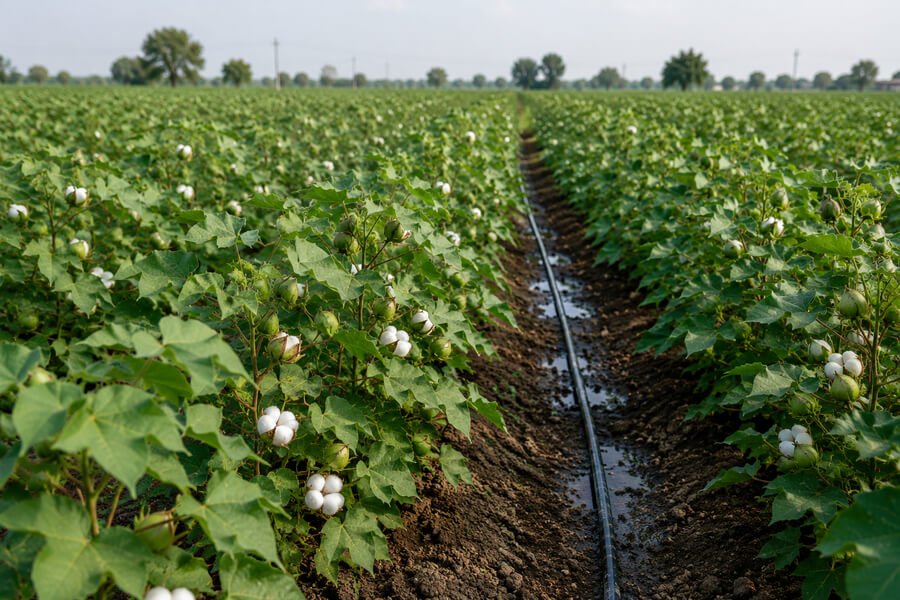
Boll formation in August is the most water-sensitive stage in cotton farming. This guide explains how drip irrigation scheduling, fertigation, and pressure management during this window directly determine final yield for cotton farmers.
August is the month that makes or breaks a cotton crop. By this point, your plants have moved past vegetative growth and entered boll formation, the stage where every irrigation decision has a direct, measurable impact on how many bolls develop, hold, and fill properly. Miss a watering cycle here and bolls drop. Overwater and root health suffers at exactly the wrong time.
Drip irrigation gives cotton farmers the precision this stage demands. Instead of flooding rows and hoping the water reaches the root zone evenly, drip delivers moisture directly where the cotton plant needs it most, consistently, across every row in the field.
In this guide, you'll learn how to manage drip irrigation scheduling, water volume, and fertigation specifically for August boll formation, so your crop reaches harvest with the yield it was always capable of.
Managing drip irrigation for cotton in August means adjusting both frequency and volume to match the crop's peak water demand. Boll formation is the highest water-consuming stage in the cotton growth cycle, and a plant that gets inconsistent moisture during this window responds by shedding bolls rather than holding them.
The general recommendation from Tamil Nadu Agricultural University is to maintain soil moisture at 60 to 70% of field capacity throughout the boll formation stage. With drip irrigation, you achieve this by shortening intervals between irrigation cycles rather than increasing volume per cycle.
Watering more frequently in smaller doses keeps the root zone consistently moist without waterlogging, which cotton roots are particularly sensitive to in warm August conditions.
A cotton farmer in Virudhunagar who switched from flood irrigation to drip irrigation midway through the season noticed something specific during August. His boll retention improved noticeably in drip-irrigated rows compared to the flood-irrigated sections he kept running alongside. The difference wasn't the total water applied. It was the consistency of delivery.
Cotton water requirement peaks between 6 to 9 mm per day during boll formation, depending on temperature and evapotranspiration levels in your region. August conditions across Tamil Nadu and Andhra Pradesh typically push daily crop water demand toward the higher end of that range.
With drip irrigation, you translate that daily demand into emitter flow rates and irrigation duration rather than guessing by visual inspection of the field.
If your laterals run emitters at 2 litres per hour with spacing of 30 cm, calculating total duration to meet daily crop water demand becomes straightforward arithmetic rather than estimation.
Getting this calculation right matters more in August than any other month.
Fertigation, delivering fertilizer directly through your drip irrigation system, gives cotton plants targeted nutrition during boll formation without the waste of broadcast application. August boll formation demands higher potassium inputs to support boll wall development and fiber quality, alongside continued nitrogen for sustained growth.
With drip irrigation, you inject these nutrients directly into the water stream using a Venturi injector or fertigation tank, reaching the root zone at the same time as moisture. This method improves nutrient uptake efficiency compared to soil application, where significant fertilizer loss occurs through leaching and volatilization.
If you haven't already set up fertigation on your drip system, KSNM's Venturi injector range makes the addition straightforward on most existing setups. Pairing water and nutrition delivery in one cycle reduces labour, cuts fertilizer waste, and keeps root zone conditions stable during the most demanding crop stage.
The most common scheduling mistake in August is carrying over the irrigation frequency from the vegetative stage without adjusting for increased demand. Cotton plants consume significantly more water during boll formation, and a schedule that worked through June and July becomes inadequate by mid-August.
The second mistake is irrigating during peak afternoon heat. Water applied between 11 AM and 3 PM experiences higher evaporation loss before it reaches the root zone effectively. Early morning irrigation, between 5 AM and 8 AM, improves water availability at the root zone and reduces the thermal stress on bolls during the hottest part of the day.
Drip irrigation also makes it easier to spot system issues that affect scheduling accuracy. A clogged emitter in August doesn't just reduce water delivery to one plant. During boll formation, that single plant may drop its entire boll load within days of water stress.
Checking emitters and flushing laterals before the critical August window helps you avoid those losses entirely. KSNM's guide on dripper clogging causes and prevention covers exactly what to look for before the season peaks.
August boll formation is the stage where drip irrigation either earns its place on your cotton farm or exposes every gap in your setup. Consistent soil moisture, accurate volume delivery, and targeted fertigation during this window directly determine how many bolls your crop holds and how well they fill before harvest.
Adjust your irrigation frequency upward this August, move your cycles to early morning, and check your emitters before the critical window opens. Explore KSNM's complete drip irrigation range to find the right system for your cotton farm, or contact KSNM Drip for guidance matched to your field conditions.





 Drum Seeder and Cono...
September 02, 2026
Drum Seeder and Cono...
September 02, 2026
 Jasmine and Marigold...
August 27, 2026
Jasmine and Marigold...
August 27, 2026
 Understanding KSNM's...
August 20, 2026
Understanding KSNM's...
August 20, 2026
 Water Crisis 2026: W...
August 06, 2026
Water Crisis 2026: W...
August 06, 2026
 Cotton Drip Irrigati...
August 13, 2026
Cotton Drip Irrigati...
August 13, 2026
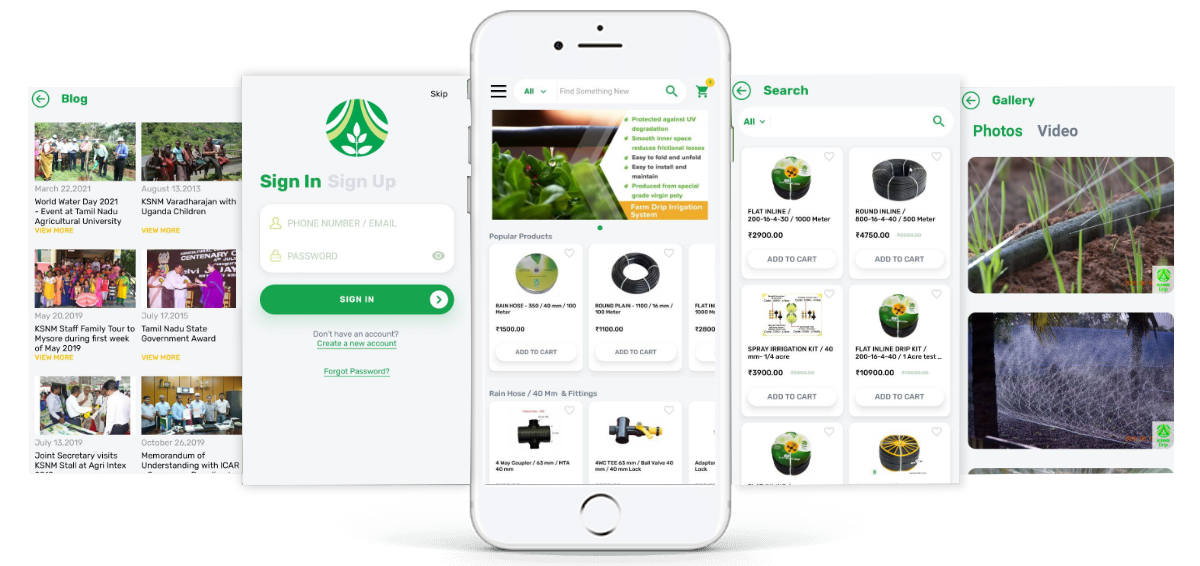
Introducing KSNM Drip’s Mobile App
Through our app’s convenience, start enjoying easy access, better experience and simple payment process. Download our App and begin your cart buying right away.


 Special offer!
 Track Order