Posted On: February 07, 2026
Posted By: KSNM DRIP
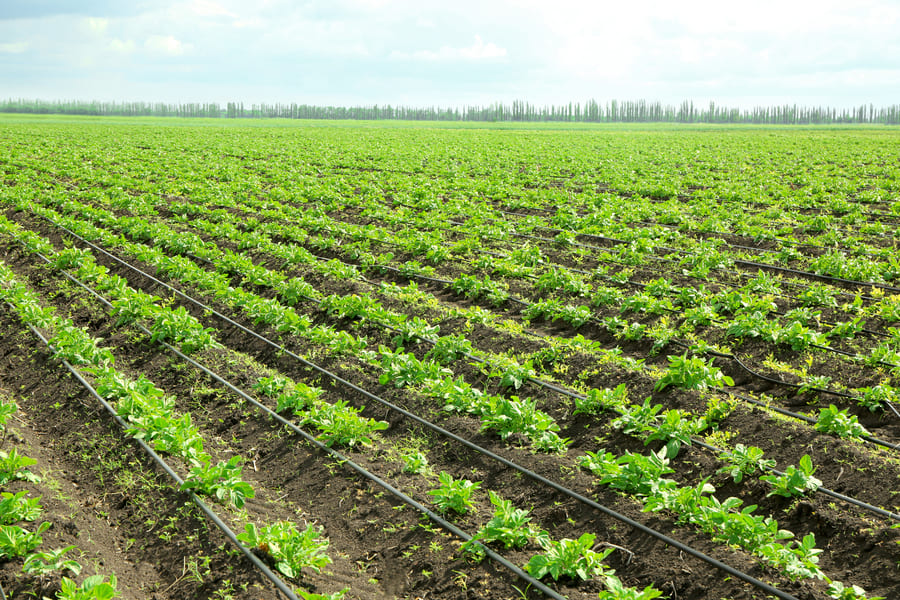
Row-crop farming is moving beyond circular wet patches. This blog explains how drip irrigation delivers uniform root-zone moisture, improves yields, saves water, and transforms the way farmers grow crops in straight rows.
For decades, irrigation in row-crop farming followed a familiar pattern: wet circles around plants, uneven soil moisture, and water loss between rows. It worked, but not efficiently. Today, as water scarcity and input costs rise, farmers are being pushed to rethink how irrigation should really serve their fields. This is where drip irrigation steps in, not as an upgrade, but as a complete shift in thinking.
Simply put, drip irrigation redefines row-crop farming by delivering water precisely along the crop line, instead of spreading it in circles that waste moisture and energy. In this article, we explore how moving beyond the circle is helping farmers improve crop uniformity, increase yield, and make every drop count.
Why Traditional Irrigation Falls Short in Row Crops
Row crops such as vegetables, cotton, sugarcane, groundnut, and maize are planted in straight, continuous lines. Yet, many traditional irrigation methods still apply water in a scattered or circular pattern. This mismatch creates zones of excess moisture near the plant and dry soil between rows, where roots rarely benefit.
Over time, this uneven watering leads to stressed plants, shallow root systems, and nutrient loss through leaching. Drip irrigation addresses this fundamental inefficiency by aligning water delivery with how crops are actually planted and how roots naturally grow—horizontally along the row.
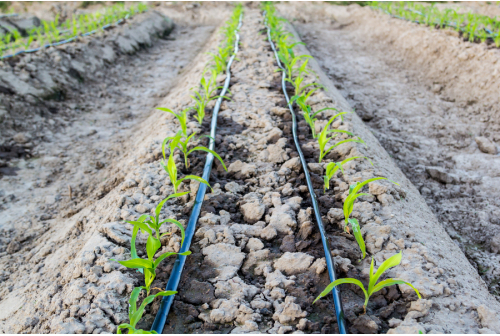
Drip irrigation works on a simple but powerful principle: water should follow the crop, not the other way around. Instead of wetting large surface areas, drip lines run parallel to crop rows, releasing water slowly and consistently along the root zone.
This alignment ensures that every plant in the row receives similar moisture levels, regardless of its position in the field. The result is uniform crop growth, reduced competition for water, and better nutrient absorption. For row-crop farming, this precision turns irrigation from a broad action into a targeted strategy.
Root-Zone Precision and Its Impact on Yield
One of the most significant advantages of drip irrigation in row crops is how it shapes root development. When water is applied evenly along the row, roots grow deeper and more uniformly, anchoring plants firmly and improving their ability to absorb nutrients.
Healthier root systems translate directly into stronger plants and higher yields. Studies in row-crop agriculture have shown that drip irrigation can improve water-use efficiency by up to 40–60%, while also stabilising yields across the field. Instead of a few strong plants and many weak ones, farmers see consistency, an outcome every grower values.
Row-crop fields are often long and expansive, making pressure loss and uneven water distribution common challenges. Drip irrigation systems are designed to manage these realities by maintaining controlled flow rates over long distances, even when terrain or field length varies.
This controlled delivery prevents over-irrigation at the start of the row and under-irrigation at the end. In practical terms, it means less water wasted, fewer corrections needed, and more predictable irrigation outcomes. For farmers managing large row-crop acreage, this reliability reduces both risk and operational stress.
Beyond water, drip irrigation changes how nutrients are delivered to row crops. When fertilisers are applied through drip systems, nutrients move directly into the active root zone instead of being broadcast across the field.
This precision feeding reduces fertiliser loss, improves uptake efficiency, and lowers overall input costs. Crops receive nutrients steadily rather than in sudden spikes, supporting balanced growth throughout the season. In row-crop farming, where margins matter, this combination of water and nutrient efficiency can significantly improve profitability.
As climate variability increases, row-crop farmers need irrigation systems that adapt quickly to changing conditions. Drip irrigation supports this shift by allowing precise control over timing and quantity, making it easier to respond to heat stress, dry spells, or unexpected rainfall.
By reducing runoff, evaporation, and deep percolation losses, drip irrigation also supports sustainable farming practices. Fields remain productive without exhausting water resources, helping farmers build resilience against long-term environmental challenges.
Row-crop farming is no longer about wetting soil in circles and hoping for the best. It is about precision, consistency, and efficiency, and drip irrigation delivers all three. By aligning water delivery with crop rows, drip irrigation transforms how plants grow, how roots develop, and how resources are used.
Thinking beyond the circle means embracing an irrigation approach that works with the crop, not against it. For farmers seeking higher yields, better water efficiency, and long-term sustainability, drip irrigation is not just redefining row-crop farming, it is shaping its future.





 Drum Seeder and Cono...
September 02, 2026
Drum Seeder and Cono...
September 02, 2026
 Jasmine and Marigold...
August 27, 2026
Jasmine and Marigold...
August 27, 2026
 Understanding KSNM's...
August 20, 2026
Understanding KSNM's...
August 20, 2026
 Water Crisis 2026: W...
August 06, 2026
Water Crisis 2026: W...
August 06, 2026
 Cotton Drip Irrigati...
August 13, 2026
Cotton Drip Irrigati...
August 13, 2026
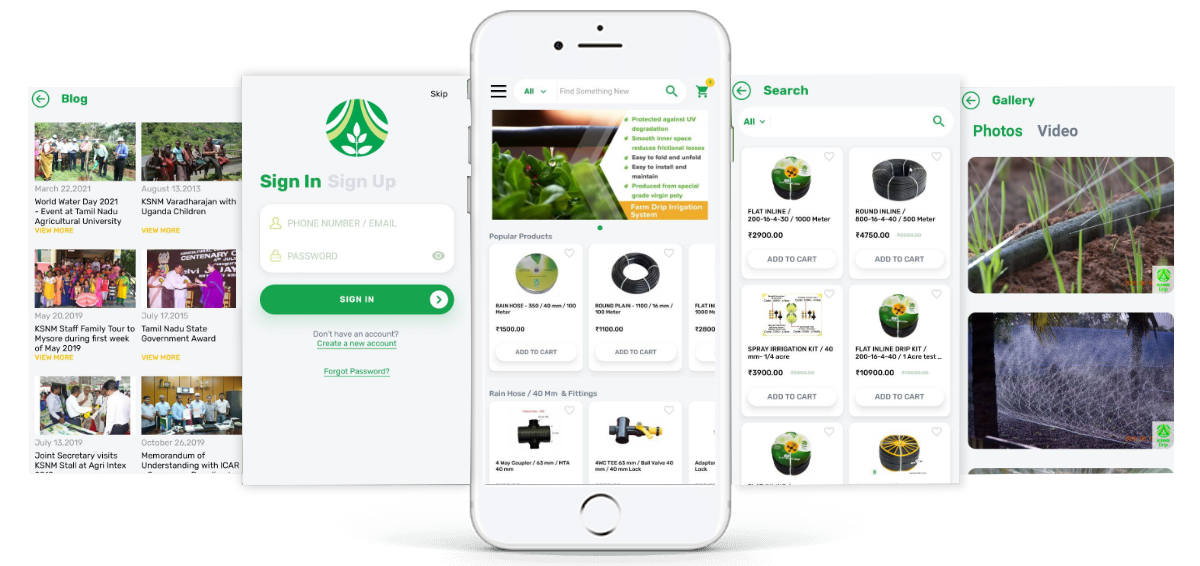
Introducing KSNM Drip’s Mobile App
Through our app’s convenience, start enjoying easy access, better experience and simple payment process. Download our App and begin your cart buying right away.


 Special offer!
 Track Order